Fleet Intelligence with OpenRouteService in Snowflake and CARTO


For logistics and fleet intelligence, routing capabilities have historically been a workload that lives outside the core analytics stack. Geocoding, directions, isochrones and route optimization typically run on the APIs of a 3rd party Location Data Services provider. That model works well and remains a valid choice for many production scenarios. But Snowflake customers who want their routing workloads to run inside the same governed environment as their data now have another option.
Snowflake’s OpenRouteService Native App, available through Snowpark Container Services, closes that gap. OpenRouteService (ORS), which is the open-source routing engine behind countless logistics and mobility applications, now runs entirely inside the Snowflake perimeter, exposed as plain SQL functions. No external API calls or data egress. Everything is self-contained.
With CARTO, those SQL functions come to life inside visual analytical workflows and interactive maps. Our new Workflows extension package for Snowflake’s ORS native app wraps each routing function as a drag-and-drop component, composable into analytical pipelines that analysts, data scientists and engineering teams can build, share and re-run. And because every CARTO Workflow can be exposed as an MCP tool, those pipelines become available to AI Agents inside CARTO Builder, Snowflake Intelligence, Cortex Code and your agentic platform of choice.
In this post we’ll look at how the Snowflake ORS Native App works, walk through the CARTO Workflows extension package that brings it into the low-code canvas, and show what becomes possible when those workflows are exposed as MCP tools to AI Agents with a fleet-intelligence example tying it all together.
Snowflake’s OpenRouteService Native App
The ORS Native App is a self-contained routing engine running on Snowpark Container Services inside the customer’s Snowflake account. The same engine that powers OpenRouteService externally is exposed here as SQL-callable functions.
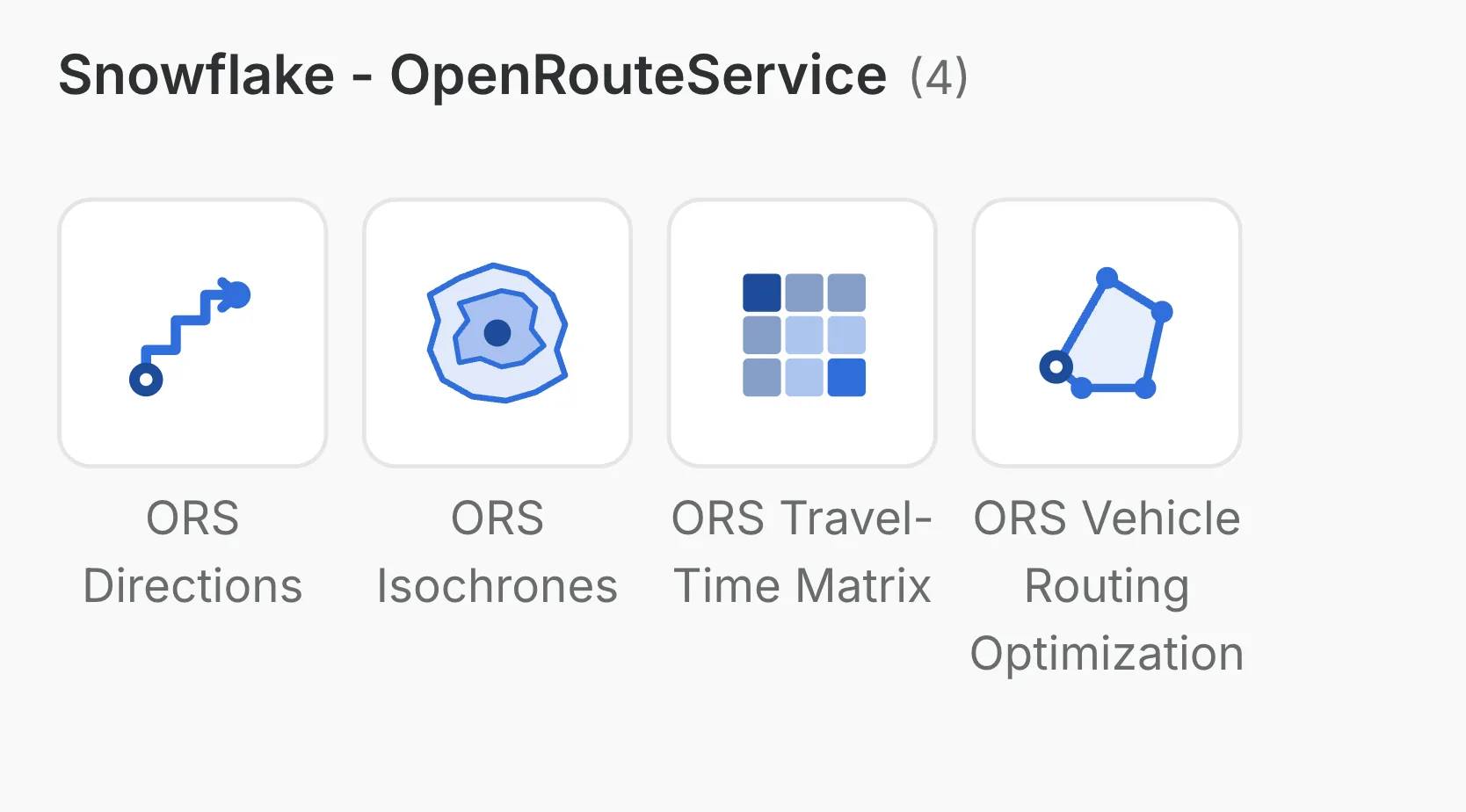
The four core functions are:
- DIRECTIONS: the optimal route between two points (driving, cycling, walking).
- ISOCHRONES: travel-time reachability polygons from one or more origins.
- MATRIX: time and distance between many origins and many destinations.
- OPTIMIZATION: solving the vehicle routing problem with constraints (capacities, time windows, multiple vehicles).
Because everything runs inside Snowpark Container Services, the routing engine sits on the same governance, security and compute fabric as the rest of the customer’s Snowflake platform.
A CARTO Workflows extension package for ORS
The CARTO Workflows extension package for Snowflake ORS wraps each of those SQL functions as a Workflows component. Workflows Extension Packages are the mechanism we use to bring third-party and partner capabilities into the low-code canvas: drop the component in, wire up the inputs, set parameters, and run.
With our integration of Snowflake’s ORS functions in Workflows, users can now:
- Generate isochrones around a network of distribution centers to study coverage gaps.
- Compute a distance matrix between every store and every customer, then join the result to demand data to plan deliveries.
- Run vehicle route optimization with capacity and time-window constraints over a fleet of hundreds of vehicles, and visualize the output on a CARTO map.
- Create point-to-point routes, and score those routes against demographic, mobility, or risk data from CARTO’s Data Observatory.
Each component is a parameterized step in a pipeline you can save, share, schedule, and version. There is no glue code, no API key juggling, and no movement of data out of Snowflake: the component pushes down SQL calls against the ORS Native App function in the same account where the data lives.
From Workflows to MCP tools for AI Agents
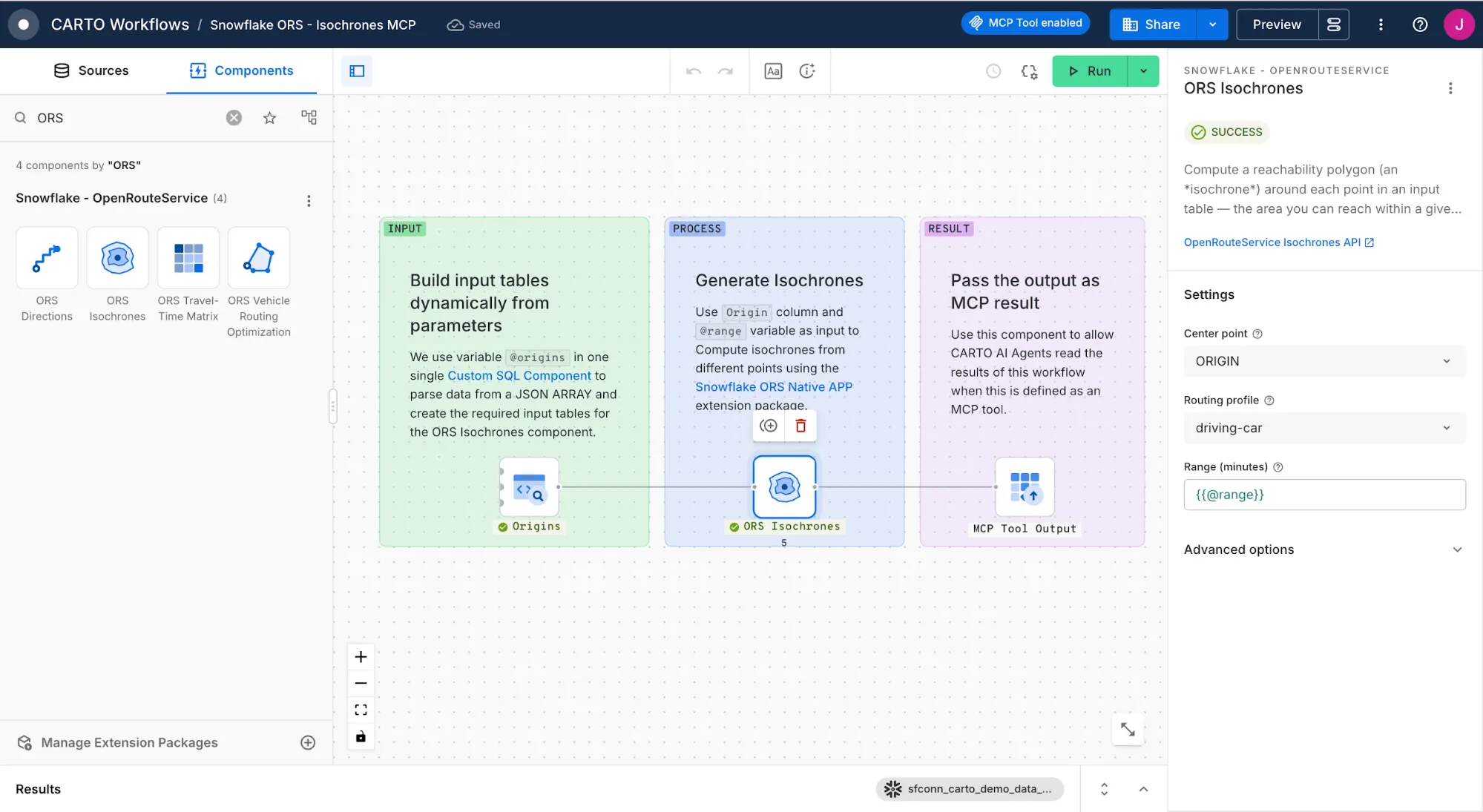
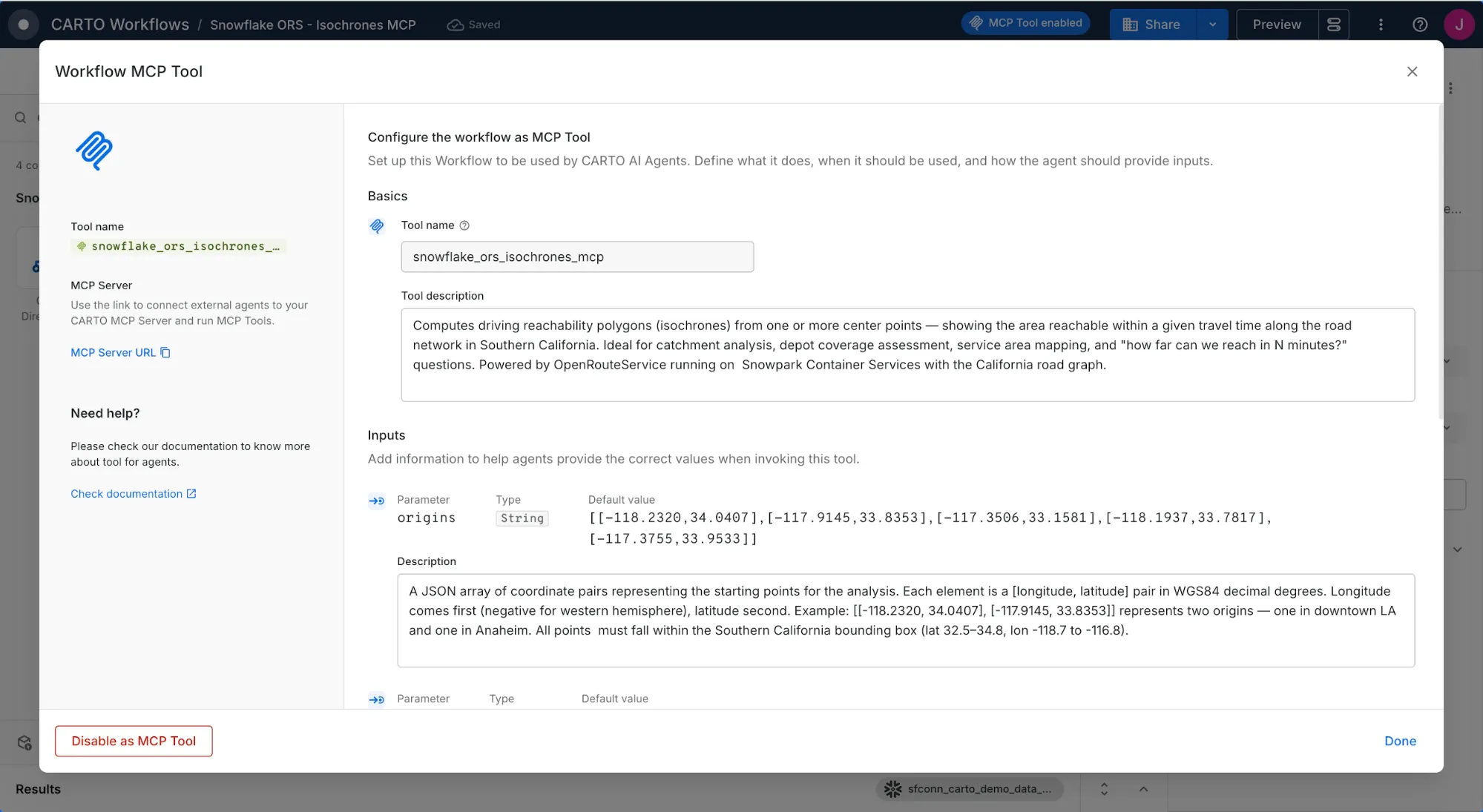
A CARTO Workflow is more than a pipeline. With the CARTO MCP Server, any parameterized Workflow can be published as an MCP tool: a callable, typed function that any MCP-compatible agent can discover and invoke.
This is what turns the extension package from a productivity tool for analysts into a building block for Agentic GIS systems. The same routing pipelines an analyst composes in the Workflows canvas become deterministic tools that an AI Agent can call autonomously. When the agent calls them, the workflow runs in the customer’s Snowflake account, the ORS functions execute inside Snowpark Container Services, and existing access controls and audit trails remain in force.
See it in action: an AI Agent for fleet intelligence
To show the whole integration with Snowflake’s ORS native app working in CARTO, we’ve built an example use-case around a fleet management company in California operating a network of depots from which trucks deliver goods to locker facilities and to customers’ homes. Behind the scenes sit four parameterized CARTO Workflows, one per ORS function: isochrones, directions, matrix and the VRP-based optimization. Each workflow takes the inputs an analyst would normally pass to the underlying ORS function (origins, destinations, fleet definition, capacities, time windows, and so on) and returns a clean spatial result. All four are published as MCP tools through the CARTO MCP Server.
On top of that we’ve built a CARTO Builder map that carries the operational data the agent needs to ground its decisions: depot locations, locker facilities, and customer home addresses. Attached to the map is a CARTO AI Agent with those four MCP tools at its disposal.
A fleet manager can ask questions in natural language; the agent identifies the inputs from the data on the map and from the conversation, calls the relevant MCP tools in sequence, and returns the answer with a text-based summary with the key numbers, and visual insights drawn directly into the map (route lines, reachability polygons, highlighted orders) alongside interactive charts in the agent panel.
Compatible with Cortex Code and Snowflake Intelligence
Very recently we have launched CARTO for Agents, making CARTO the first GIS platform fully designed for the Agentic Enterprise. Now, coding agents like Snowflake’s Cortex Code have access to all the capabilities of the CARTO platform via the CARTO CLI, Agent Skills and the CARTO MCP Server. This means that Snowflake users can now operate CARTO via Cortex Code, enabling the agentic creation of workflows and interactive maps.
The CARTO MCP Server is also a front door for the rest of the agentic ecosystem, which means the same geospatial analyses are equally callable from Snowflake Intelligence. The fleet manager in our scenario could just as well be having that conversation inside a Snowflake Intelligence interface, with the agent reaching the same workflows in the same governed environment.
Try it today
The CARTO Workflows extension package for Snowflake ORS is available now: install it in CARTO Workflows, and point it at a Snowflake account where the ORS Native App is deployed. If you would like to learn more, please do not hesitate to request a demo. You can also meet us at Snowflake Summit, June 1–4. Come see this in action and talk to the CARTO team about your use cases and Snowflake setup.