The Per-Seat Trap: How Consumption Pricing Opens Spatial Analytics to Everyone


Most organizations don't have a geospatial data problem. They have an access problem. The data exists and the business questions are clear. What's often missing is a practical way to put spatial analytics in the hands of the teams making decisions every day.
Too often, that gap is created by pricing models designed for a different generation of GIS software.
For most of its history, geospatial and Location Intelligence software, what most people still call GIS, has been sold the same way: by the seat or concurrent license. The industry incumbents built their businesses on named-user and concurrent licensing, where a single GIS software license can cost anywhere from roughly $1,000 to more than $10,000 per year, with additional capabilities gated behind user types, extensions, and credit systems.
That model made sense in a world where geospatial was a specialist discipline practiced by a small number of trained specialists working at dedicated workstations. But that world no longer exists, and the pricing model that served it is now actively working against the way modern organizations want to use spatial data.
More importantly, seat-based models force organizations to lock the value of Location Intelligence behind maps pasted into PowerPoint decks, PDFs, spreadsheets, and emails. Instead of enabling decisions across the organization, spatial analysis becomes a service delivered by a small team to everyone else.
"...seat-based models forces organizations to "lock" the real business contribution of geospatial analytics behind maps pasted in decks or pdfs that are shared internally via email"
The hidden cost of per-seat GIS
The biggest problem with per-seat licensing is the behavior it creates.
When every additional user carries a meaningful cost, organizations naturally ration access. GIS becomes something a small group of specialists do on behalf of everyone else. Business teams submit requests while analysts build maps and reports. Results are exported and shared. Then the cycle starts again, and over time, Location Intelligence becomes trapped inside a service model rather than embedded into everyday decision-making.
When seats are constrained, companies ration access, and a platform that should be enterprise-wide infrastructure shrinks into a tool for a small team (SoftwareSeni).
For organizations serious about democratizing and scaling geospatial analytics, this is a hard constraint. It limits adoption, slows impact, and keeps Location Intelligence from reaching the people who need it most. If you are evaluating geospatial platforms, it's worth understanding how different models handle access and scale.
At the same time, demand for spatial insights is growing far beyond GIS teams. It now reaches operations, marketing, supply chain, and planning. Yet when access is tied to a fixed number of licenses, leaders are forced to ration insights instead of scaling them. In simple terms, they must decide who gets answers and who has to wait.
The result is slower decisions, longer backlogs, data fragmentation, and less value created from the data they already own.
Per-seat licensing is only one line on a much larger bill. To see how these hidden costs add up across licensing, infrastructure, data engineering, and staffing, explore our framework for calculating the total cost of ownership of a legacy GIS.
Software has already moved on
Step back from geospatial for a moment, because what's happening in our market is part of a much larger shift. Software as a whole is moving toward consumption pricing, and not at the margins. It has become the mainstream.
As of early 2025, approximately 85% of software companies have adopted some form of usage-based pricing, up from just 35% in 2020. Industry experts including Gartner expect usage, agent, and outcome-based pricing models to account for a growing share of enterprise software spending over the next decade as traditional seat-based licensing continues to decline.
The largest software companies and the fastest-growing startups are converging on the same pricing model, an indicator the market has repriced itself. The reason comes down to alignment: a seat license is a fixed cost that exists whether the software gets used or not. If a seat costs $1,000 per year, you pay that $1,000 whether the user logs in every day or twice a quarter.
The cost is disconnected from the value being created. Consumption pricing flips that relationship. It follows actual usage. Light usage costs little and heavy usage costs more. Spend rises and falls with the value being delivered.
"...you pay that $1,000 regardless of whether the person logs in every day or twice a quarter. The cost is decoupled from the value. Consumption pricing flips that relationship. It tracks the actual demand curve of the business impact…"
For customers, that's a far more honest model. You stop paying for shelfware, buying licenses years in advance, and rationing access to control costs. Instead, your software spend aligns more closely with the value you actually receive, not a contract negotiated years ago for a team, workload, and business that have since evolved.
The cloud changed the model
Two forces are accelerating this shift in geospatial specifically: cloud data platforms and AI.
Today, more than 90% of enterprises run some form of data warehousing, and the platforms they're standardizing on (Snowflake, BigQuery, Databricks, Redshift, and others) are consumption-based at their core. Organizations already pay for compute, storage, and queries based on usage, and as spatial analytics increasingly runs directly inside those environments, the economic model naturally follows.
The question has shifted from how many GIS analysts need access to how much spatial analysis the organization is running.
AI makes per-seat pricing impossible
The arrival of AI agents also fundamentally breaks the assumptions behind seat-based licensing.
Historically, software was purchased for people. A named user logged in, performed work, and logged out. Counting users made sense because users were the primary consumers of the platform. But AI changes that equation.
A coding agent can build workflows, run analyses, enrich datasets, create maps, and answer questions without ever occupying a traditional software seat. A single analyst may be supported by multiple agents. A workflow may execute thousands of spatial operations automatically. An application may generate AI and SQL usage behind the scenes without a human ever opening a GIS interface.
Value now lives in the work being performed, not in the number of users with a login. Especially as organizations adopt AI-powered analytics, the conversation shifts from:
"How many people need access?" to "How much analysis are we running?"
Consumption pricing aligns naturally with that future because it measures usage rather than headcount. Simply put, there is no meaningful definition of a "seat" when AI agents can generate insights at machine scale and run automated workflows around the clock. In a world where humans and AI work side by side, value is created through outcomes and consumption, not the number of licensed users.
The traditional seat-based model was not designed for this new way of working.
Why CARTO is making this change
This is why CARTO is moving to consumption-based licensing. It reflects how spatial analytics is actually built and used today. Spatial analytics now runs in the cloud, directly on cloud data warehouses, through APIs and AI agents, and at a scale that extends across the organization, not just a small group of licensed users.
Under this model, organizations can provide broad access to Agentic GIS without the burden of purchasing expensive licenses for every individual user. Teams that previously had to limit access based on license availability can now empower far more employees to explore, analyze, and act on spatial insights. For many organizations, users who once required thousand-dollar GIS seats can now access spatial capabilities at a fraction of the cost.
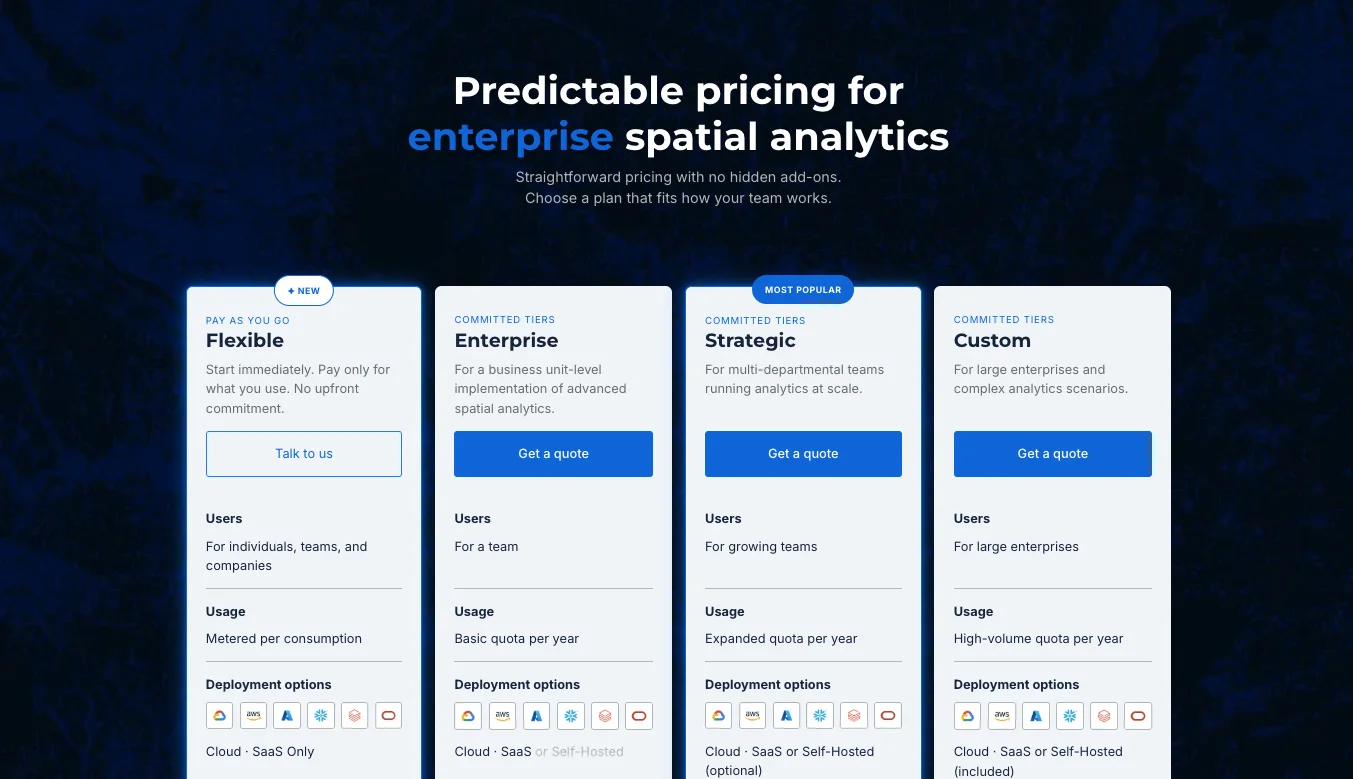
For organizations seeking greater flexibility, we've introduced a flexible pay-as-you-go option. This allows teams to get started quickly, test new use cases, and scale at their own pace without committing to large multi-year contracts upfront. Rather than paying for anticipated demand, customers can start small and grow alongside their actual usage and realized value.
Most importantly, as adoption expands, costs scale with the value being generated for the business, not with arbitrary license counts. That's a better model for cloud platforms, AI, and ultimately for customers.
What this means for organizations
For CARTO customers, consumption pricing expands who can participate.
Instead of limiting access to a fixed number of users, organizations can extend spatial analytics across teams. Analysts can build workflows or MCP tools for AI agents once and share them broadly. Business users can explore maps, dashboards, and AI-powered experiences without becoming technical experts. Developers can embed geospatial analytics directly into web applications. AI agents can execute approved geospatial workflows and manage the CARTO platform at scale.
Most importantly, organizations can start small and grow based on actual usage rather than forecasting seat counts years in advance.
The result is a simpler model:
- Lower barriers to adoption
- Broader access across the organization
- Less shelfware
- Faster time to value
- Costs that scale alongside business impact
The future of geospatial
The future of geospatial is not more seats. It's more people, applications, and agents using Agentic GIS every day. Consumption pricing removes the barriers that have historically limited access to GIS and aligns costs with the value being created. As geospatial becomes a core part of modern cloud platforms and AI workflows, pricing models must evolve alongside it.
The geospatial industry has spent decades optimizing how spatial analysis is performed. Now it's time to modernize how it's consumed. The geospatial market has been waiting for a pricing model that reflects the way the rest of the modern software already operates.
At CARTO, we believe Location Intelligence should be available to everyone who can benefit from it, not just the people assigned a license. Consumption pricing is how we get there.
To learn more, schedule time with our team and explore the new flexible pay-as-you-go model.