What is self-service analytics, really?


Every analytics tool claims it offers the holy grail of data: self-service analytics. Dashboards, BI platforms, and web maps all promise that anyone in the organization can use the tool to find the answers they need without waiting on a specialist.
But… what does that term actually mean? Self-service analytics should mean anyone can get an answer to their exact question, right away, without writing queries or waiting on a specialist.
By that definition, most of what we describe as self-service… isn’t. It’s not that the tools are bad, they’re just not allowing their users to get exact answers to specific questions.
What self-service analytics is supposed to do
The idea is simple. If more people can answer their own questions, decisions get made faster, and specialists spend their time on the analysis only they can do instead of on routine requests. Everyone wins.
The pressure to get there is growing. More people are asking spatial questions than ever: organizations running spatial analysis in the cloud are 24% more likely to see demand for analytics rising from non-technical colleagues. But the people who can answer them are hard to find, with 46% of the professionals we surveyed saying hiring people with spatial skills is difficult or very difficult.
More questions, and not enough experts to answer them. The only way to keep up is for people to get answers to their own questions.
But many so-called self-service tools just aren’t delivering that. Let’s zoom in on web maps.
Is a web map self-service analytics?
Let’s focus in on a hypothetical emergency planner at a California state agency. Ahead of a budget hearing, she’s been asked: which parts of the state are more than five minutes’ drive from a fire station, and how many people live there?
That’s easy—the GIS team has published a web map of every fire station in the state.
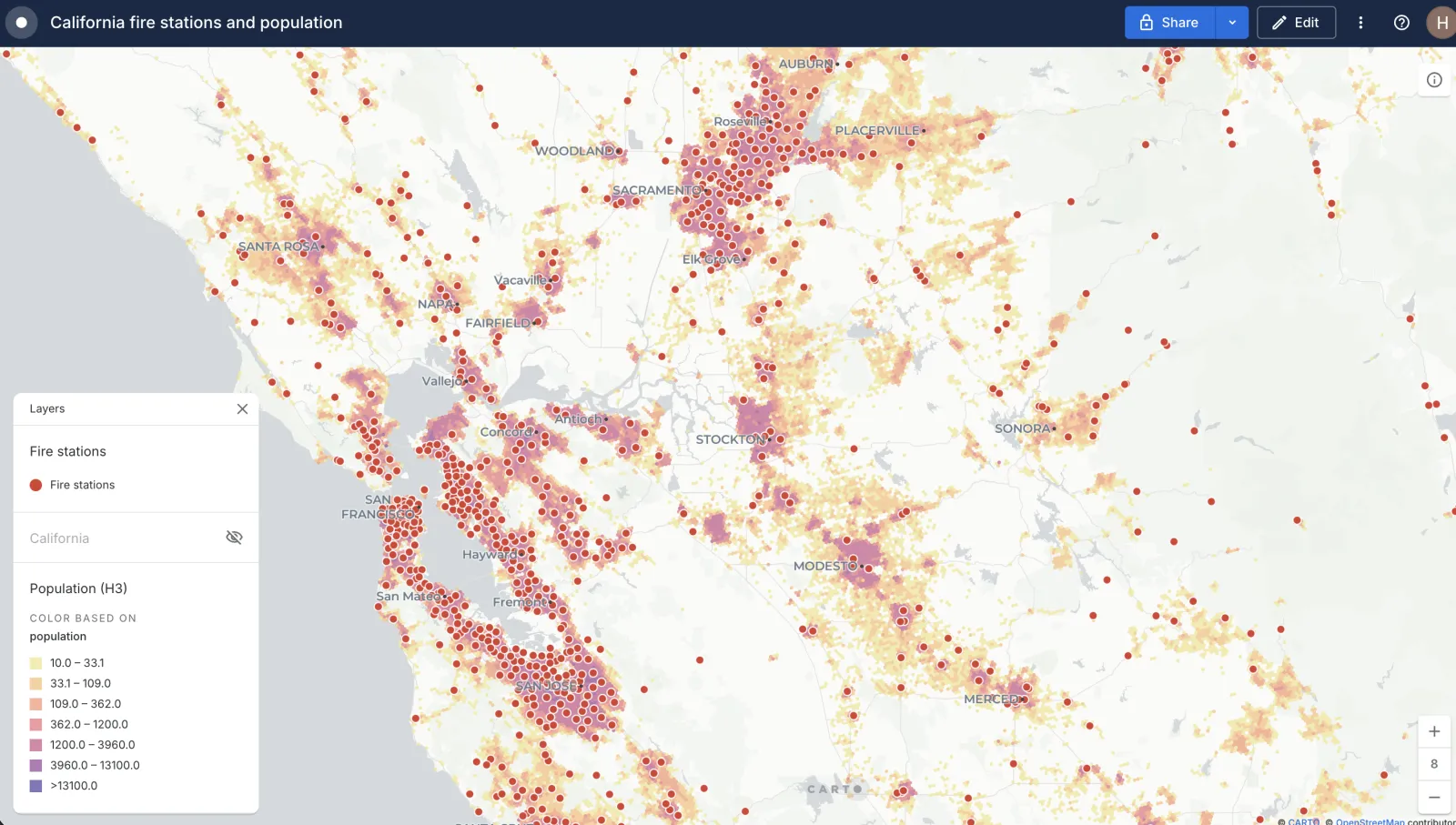
The stations are all there, and she can click on each to see how many people live within 2 km. But distance isn’t drive time, and a point can’t show how far an engine can travel in five minutes. She can eyeball which neighborhoods look far from a station, but she can’t add up how many people live in the gaps.
The map does exactly what it was built to do. It just wasn’t built for her question.
Where the queue comes from
So she files a ticket with the GIS team… and this is exactly why self-service programs often end up with more requests, not fewer. Every map and dashboard sparks follow-up questions, and they all land back with the specialists. The queue doesn’t disappear. It moves.
And in this case? The GIS team is booked solid, and the meeting is tomorrow.
Three tests for real self-service
If self-service means getting an answer to your exact question right away, any tool can be measured against three tests.
- Can people ask in their own words, in the tools they’re familiar with? No layer names, filters, or query syntax.
- Do they get an answer to their question? Not a general view to narrow down, but the specific result: the areas beyond five minutes’ reach, and how many people live there.
- Can they trust it? Governed data, the right permissions, and a method a specialist has signed off.
Dashboards, web maps, and general-purpose AI chats usually pass one or two. Passing all three is the difficult part—and is exactly what Agentic GIS is designed to do.
Agentic GIS: answers, not access
Back to the hearing. The emergency planner is presenting her best estimate when someone asks: “How many stations cover Downtown Sacramento?” The map can’t say, and the room spends ten minutes zooming and filtering for a number nobody is 100% sure on.
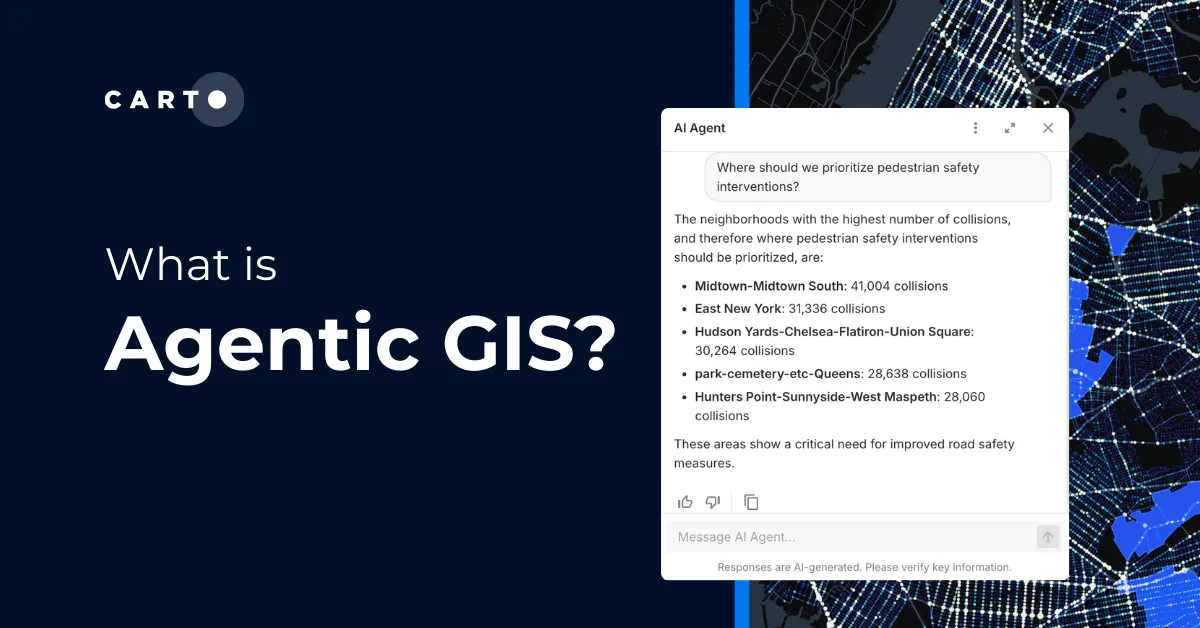
Now imagine this with an AI Agent built into the same map. She types the question exactly as it was asked. Seconds later, the stations that reach Downtown Sacramento within five minutes are highlighted and listed. No guessing, no ticket.
Try it yourself on the map below!
That’s Agentic GIS. People ask in plain language, AI Agents run the analysis, and specialists stay in control of how it’s done.
Specialists design the method once. Behind the agent sits a workflow that a GIS analyst built: five-minute drive-time areas along the real road network, counted against one agreed population dataset. The agent picks the inputs, and the workflow runs the same method every time. A general-purpose chatbot might draw circles instead, counting people across a river as covered, and give you a different number tomorrow.
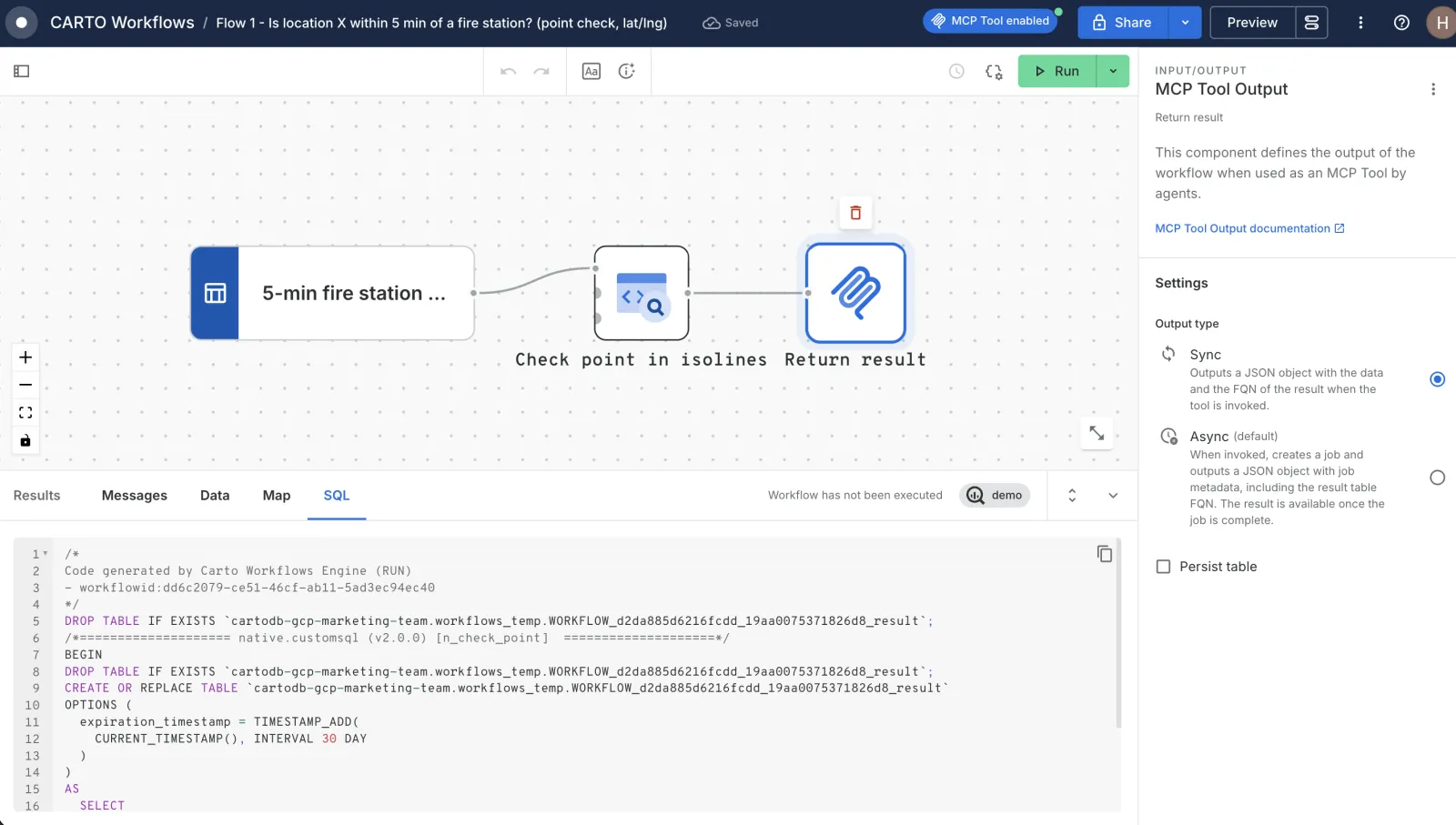
The data stays where it lives. Everything runs in your own cloud data warehouse, with the LLMs your organization has approved. Agents only see what the person asking is allowed to see.
The GIS team scales. Instead of answering the same question for the tenth time, specialists build the methods that answer it for everyone.
Access isn’t the same as answers
Self-service was never about giving more people more tools. It was about giving them answers. Maps are still one of the clearest ways to show an answer. Agentic GIS makes sure people can get one.
So, how many of your published maps answer the questions your colleagues actually ask?
Request a demo to see how your colleagues could get answers to their own questions.
Go deeper: Our playbook walks through how to build the fire station tool. Agentic GIS for the Public Sector shows, step by step, how agencies reassess coverage when conditions change, with a process that’s governed and auditable. Get the playbook.
Frequently Asked Questions
What are the benefits of self-service analytics?
Faster decisions, fewer routine requests for specialist teams, and more people using data day to day. Those benefits only hold if the answers can be trusted: governed data, the right permissions, and methods specialists have approved.
Is a dashboard or web map self-service analytics?
Partly. Dashboards and web maps give people access to data, but they depend on the user’s data literacy and only answer the questions their builder anticipated. Anything else goes back to a specialist.
How do AI agents change self-service analytics?
People ask in plain language and get a specific answer back. When agents run workflows designed by analysts instead of improvising, the answers are consistent, repeatable, and auditable.
Can you trust answers from AI agents?
Trust depends on how an agent reaches its answer. An agent that improvises its own analysis can give different answers to the same question. An agent that runs an approved workflow gives the same answer every time, and a specialist can inspect every step.