Where does my data live? How CARTO works in hybrid cloud environments


“Where does my data live?” is the first question almost every technical evaluator asks us. It comes up before pricing, before features, and often before the demo even starts. And it deserves a direct answer.
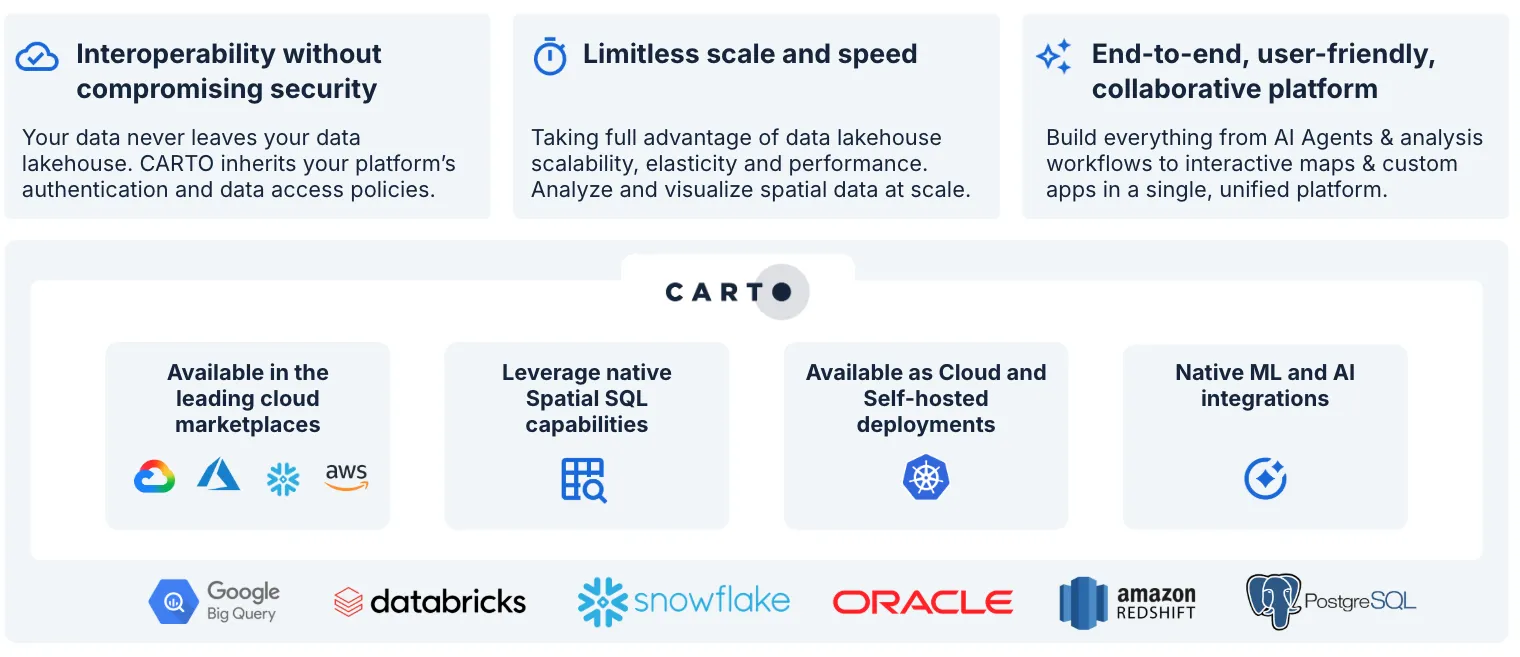
Your data lives exactly where it lives today: in your own cloud data warehouse. CARTO connects to it and runs the analysis there. Nothing is synced, copied, or moved to our servers.
This post explains how that works in practice, including the scenario more and more teams ask about: hybrid environments where data is spread across two or more platforms.
The short answer: our spatial analytics goes to the data, not the other way around
CARTO is cloud-native. It runs directly on top of Google BigQuery, Snowflake, Databricks, Amazon Redshift, and Oracle. When you build a map, run a workflow, or ask an AI Agent a spatial question, CARTO generates queries that execute inside your warehouse, using your warehouse’s compute and the spatial functions of the CARTO Analytics Toolbox.
A global bank evaluating us asked how map performance holds up with millions of data points. The answer: performance scales with your warehouse, because every computation is pushed down to it. CARTO adds the spatial logic, visualization, and applications on top. Your warehouse does the heavy lifting it was built for.
That architecture has a second benefit that security teams notice immediately. Because data never leaves your environment, CARTO inherits the spatial data governance you already have: your access controls, your row-level security, your audit trail.
“But our spatial data isn’t in one warehouse”
Fair. Most enterprise data estates are messier than an architecture slide. We have heard versions of the same setup again and again:
- A global company running a hybrid Databricks and Snowflake environment, and asking whether CARTO could connect to both. It can. One CARTO workspace can hold connections to multiple warehouses at the same time.
- A transport company with an on-premise big data platform built on S3, Delta tables, and Spark, planning an extension to Azure with Databricks. CARTO connects to Databricks with standard authentication methods, including OAuth user-to-machine flows, and integrates with Unity Catalog so existing permissions carry over.
- A retail company that wanted everything to remain within its own Azure tenant, connecting to Databricks via private endpoints. Self-hosted deployment makes that possible; you can compare the CARTO deployment options in our documentation.
Can CARTO use our existing location services and external data?
Hybrid questions do not stop at warehouses. Two related questions come up in nearly every technical evaluation:
“Can we plug in our own location services?”
Yes. Organizations with an existing geocoding or routing provider can configure CARTO to use it, rather than being forced onto a bundled service.
“Can we bring in outside data without building pipelines?”
Also yes. The CARTO Data Observatory delivers demographic, mobility, points of interest, and environmental datasets directly into your warehouse as governed tables, so enrichment happens next to your own data rather than in a separate silo.
Why data residency matters more in the agentic era of GIS
The stakes of the “where does my data live” question have gone up. When AI Agents can run spatial analysis on demand, the architecture underneath them decides whether that is safe. Because CARTO runs inside your warehouse, an agent asking a spatial question triggers the same governed, logged queries an analyst would run. Data does not get copied into a model provider’s environment to be analyzed. That is the difference between Agentic GIS and bolting a chatbot onto a mapping tool.
The questions to ask any spatial analytics vendor about data residency
If you are evaluating platforms right now, these four questions will tell you most of what you need to know:
- Does the analysis run inside our warehouse, or does data get extracted first?
- Can one workspace connect to more than one warehouse at the same time?
- Does the platform inherit our existing access controls, or does it introduce a parallel permission system?
- When AI features run, where does the data go?
We are happy to answer all four in a live session with your own environment on screen. Request a demo.