The Model Context Protocol (MCP) is an open standard, with public documentation, that lets AI applications connect securely to external tools, data sources, and systems through a unified interface. It provides a standardized way for AI agents and large language models to interact with the real world: querying databases, calling APIs, triggering workflows, and accessing enterprise resources.
What is MCP?
MCP acts as a universal adapter between AI models and external capabilities. Without MCP, every AI integration requires custom code for each tool or data source. MCP standardizes these connections so that any MCP-compatible AI application can use any MCP-compatible tool, much like how USB standardized hardware connections.
The protocol defines three types of capabilities that servers can expose:
- Tools: Functions the AI can call to perform actions (run a query, create a map layer, send an email)
- Resources: Data sources the AI can read (databases, documents, APIs)
- Prompts: Reusable templates for common interactions
How MCP Works
MCP follows a client-server architecture:
- MCP Server: A service that exposes tools, resources, or prompts following the MCP specification. For example, a spatial analytics MCP server might offer tools for geocoding, isoline generation, and spatial joins.
- MCP Host: An AI application (like Claude, ChatGPT, or a custom agent) that connects to one or more MCP servers. The host contains an internal MCP client that manages each server connection.
- Discovery: The host queries the server to learn what tools are available, their parameters, and their descriptions.
- Invocation: When the AI decides a tool is needed, it sends a structured request to the server and receives a structured response.
MCP in Spatial Analytics
MCP is particularly relevant for spatial analytics because it allows AI agents to perform complex geospatial operations without the AI needing built-in spatial capabilities. A spatial MCP server can expose tools like:
- Running spatial SQL queries against a data warehouse
- Generating isolines (drive-time or walk-time areas)
- Performing geocoding and reverse geocoding
- Creating and styling map visualizations
- Executing spatial statistics and enrichment workflows
The CARTO MCP Server exposes the platform to any MCP-compatible AI agent in three ways:
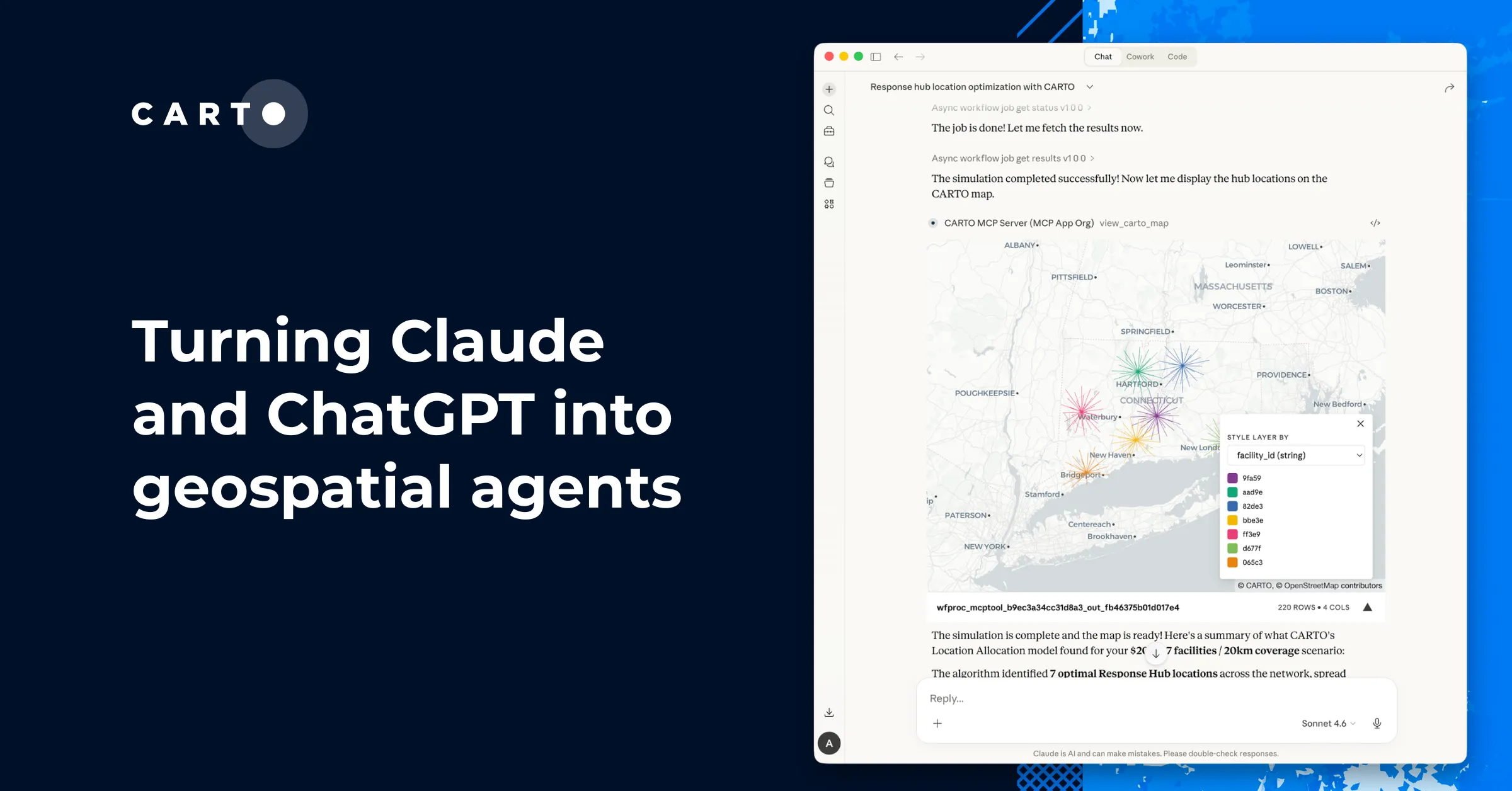
- Workflow tools: CARTO Workflows run as deterministic MCP Tools. The agent calls a versioned, audited workflow instead of generating SQL on the fly, and the analysis runs inside your governed data warehouse with no data movement.
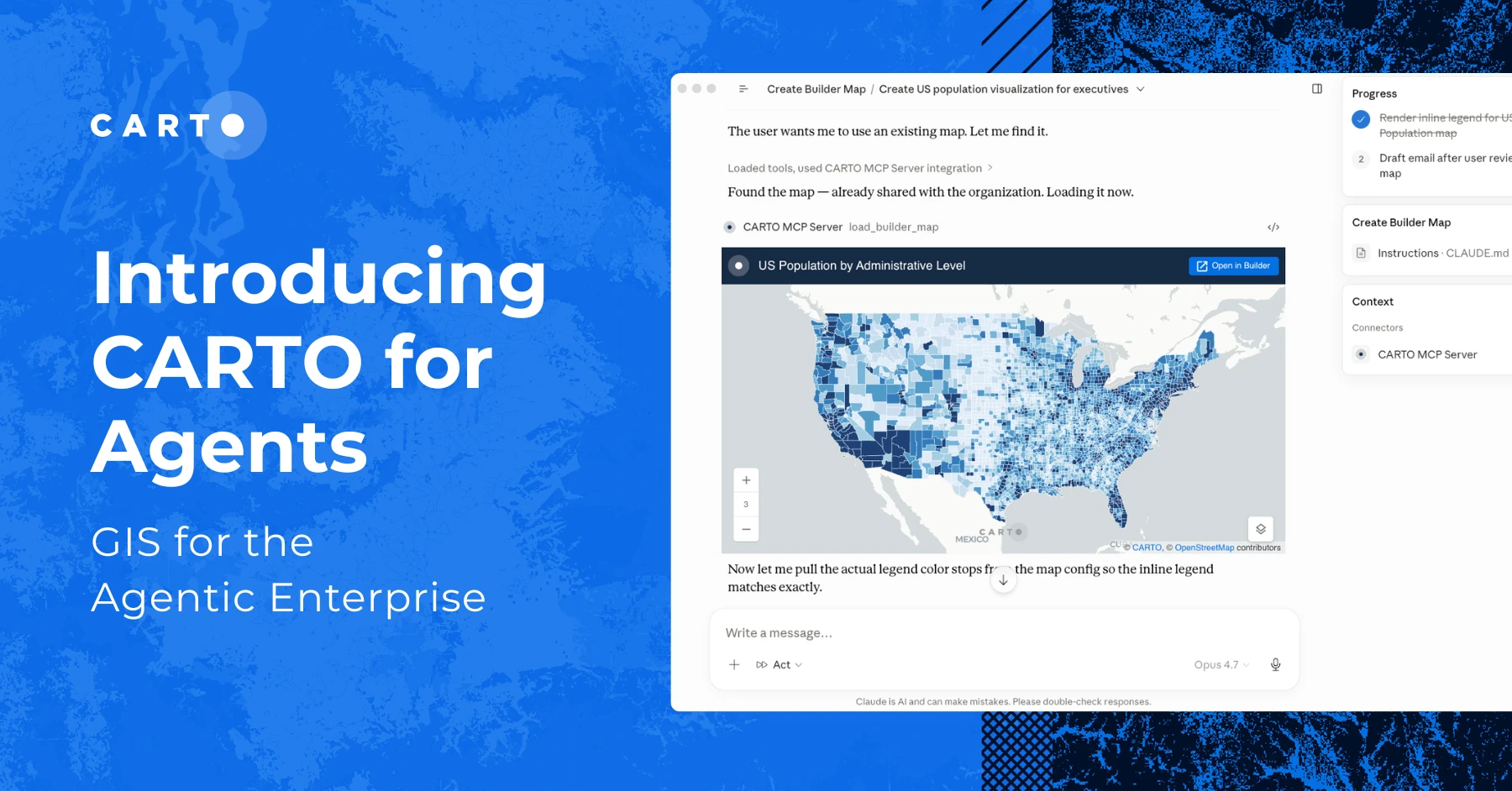
- Interactive tools: MCP Apps render fully interactive maps inside the agent conversation, as CARTO Builder dashboards or one-off visualizations using CARTO for deck.gl.
- Platform tools: Utilities that help the agent find the right data, such as listing connections and browsing tables.
Agents reach CARTO from platforms like Claude, ChatGPT, Gemini, Microsoft Copilot, and Snowflake Cortex, and every action is logged and auditable.
Why MCP Matters for Enterprise AI
- Interoperability: AI tools from different vendors can work with the same MCP servers, avoiding vendor lock-in
- Security: MCP servers can enforce authentication, authorization, and audit logging at the tool level
- Governance: Organizations control which tools are exposed and what data they can access
- Composability: AI agents can combine tools from multiple MCP servers to accomplish complex tasks
- Democratization: MCP Servers are best suited for analytical and visualization use cases and for agentic platforms that can’t run terminal commands, making geospatial accessible across the whole organization, not just technical users
Frequently Asked Questions
Who created MCP?
MCP was created by Anthropic and released as an open standard. It is supported by a growing ecosystem of AI platforms and tool providers.
How is MCP different from an API?
APIs are custom integrations between two specific systems. MCP is a standardized protocol that allows any compatible AI client to discover and use any compatible tool server. Think of APIs as point-to-point connections and MCP as a universal plug system.