Fraud Detection
Find fraud your rules can't see
Rules score transactions one by one, so clusters stay hidden. With CARTO, score them together to find patterns and anomalies.


What fraud teams run in CARTO
Find and check fraud securely in your own cloud, whether you're working with insurance claims, card payments, or digital accounts.
See the industry view for insurance and financial services.
Find fraud hotspots
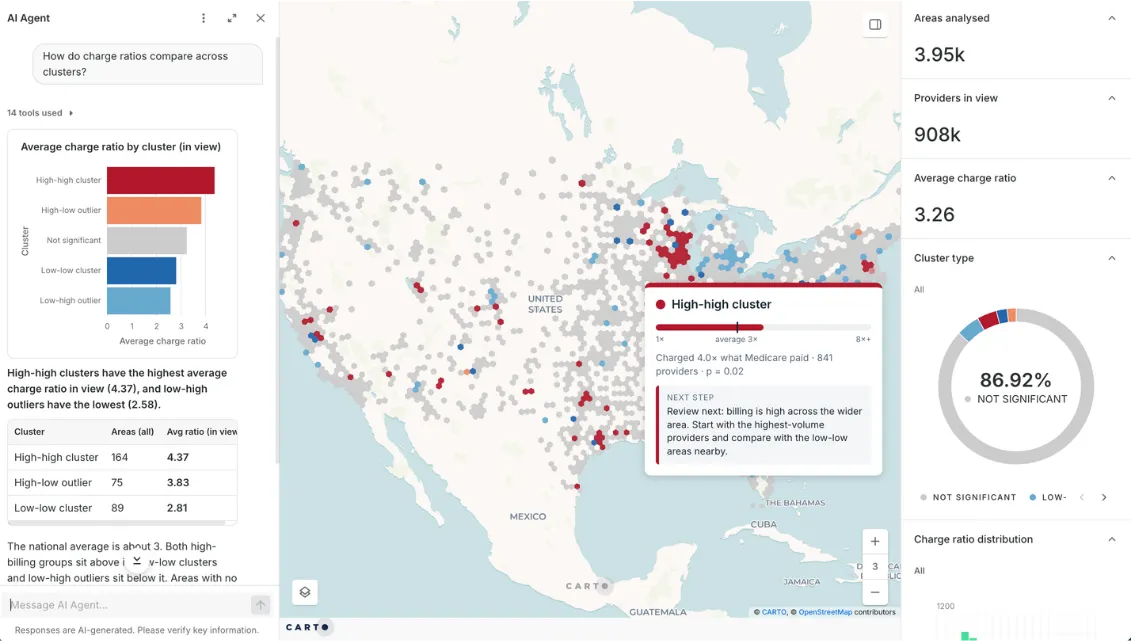
Scored one at a time, fraud that clusters in one area looks like a run of unrelated cases.
CARTO lets you group fraud signals into hotspots on an H3 grid and rank every area by how far it stands out, using hotspot analysis in a saved, reusable Workflow, which can be called as an MCP tool in your agent platform.
Check claims against events
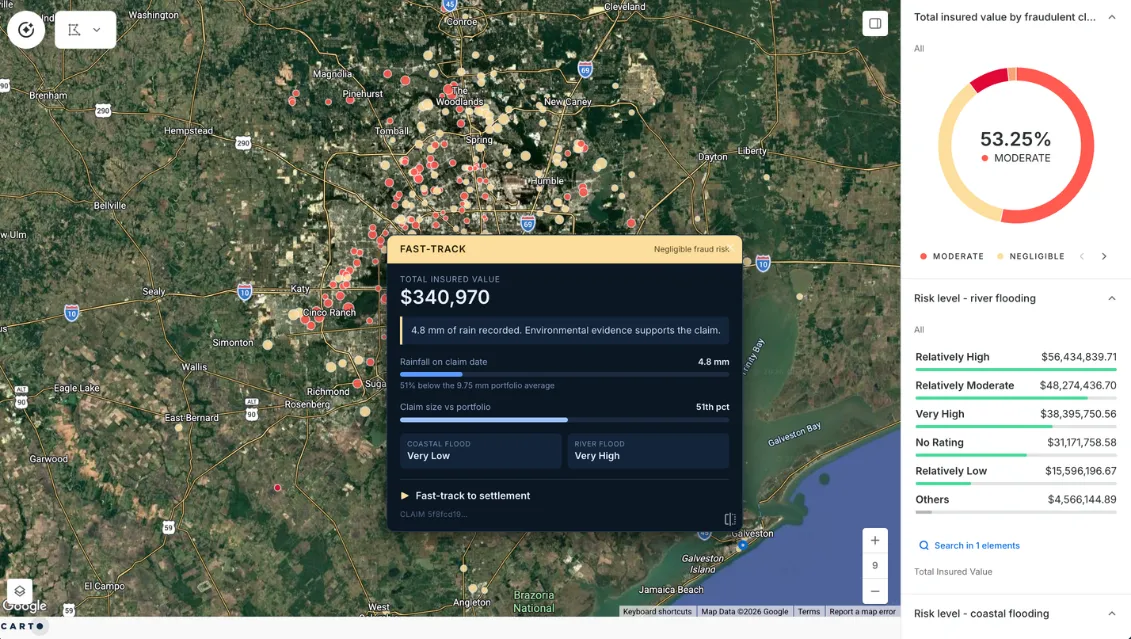
Confirming that a storm actually hit an address on the claimed date usually means a manual lookup or an inspector visit.
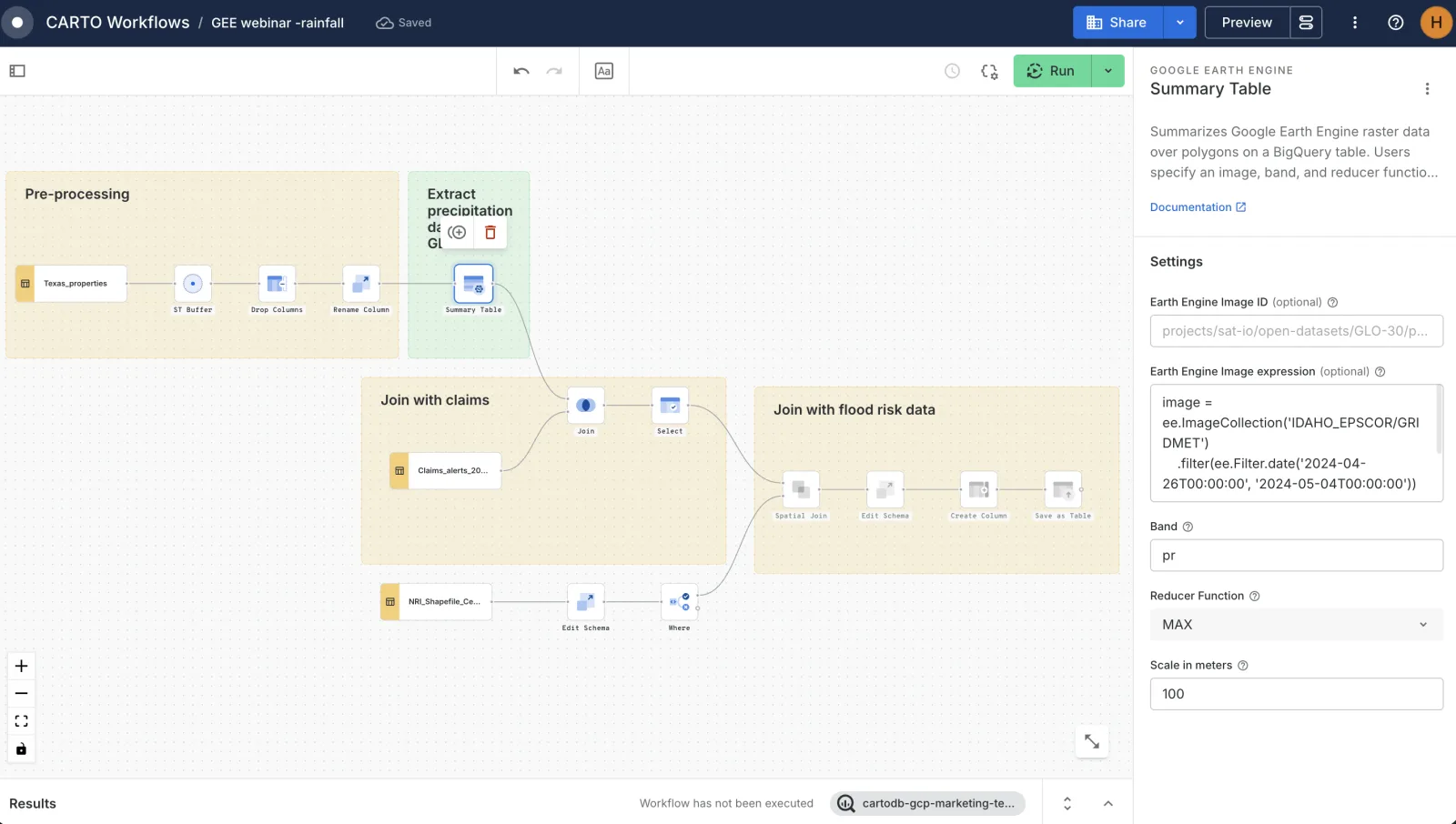
CARTO lets you join each claim to the storm, fire, or flood behind it, using weather and hazard data from the Data Observatory or from external APIs and services like Google Earth Engine, and flag the ones that don't match.
Test reported locations
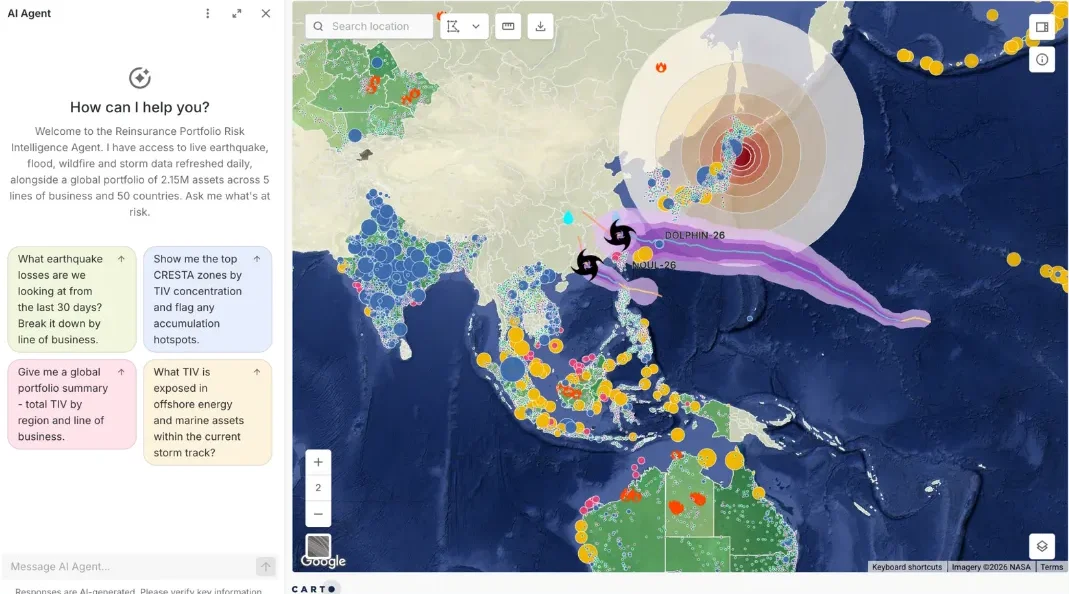
A claimed loss or a card transaction can come from somewhere it could never have happened, and nobody checks the geography.
CARTO lets you compare where something was reported with where it could have happened, using drive-time areas, flood extents, or wildfire perimeters.
Build spatial features
Fraud models often treat location as one raw column, because building features from it takes custom code.
CARTO lets you add distances, neighbor counts, and area profiles to your fraud models and refresh them on new data, all in a saved, reusable Workflow that can be called as an MCP tool in your agent platform.
Rank cases
Investigators have more cases than time, and the queue rarely says which ones to open first.
CARTO lets you score every case by risk and location, and lets investigators ask an AI Agent which ones to start with.
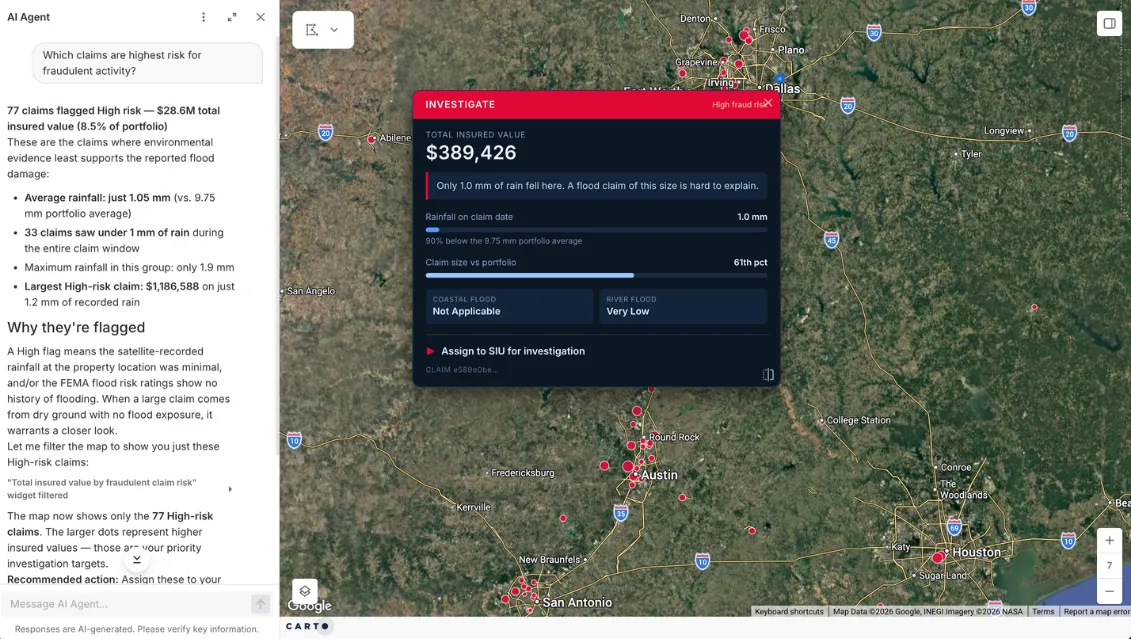
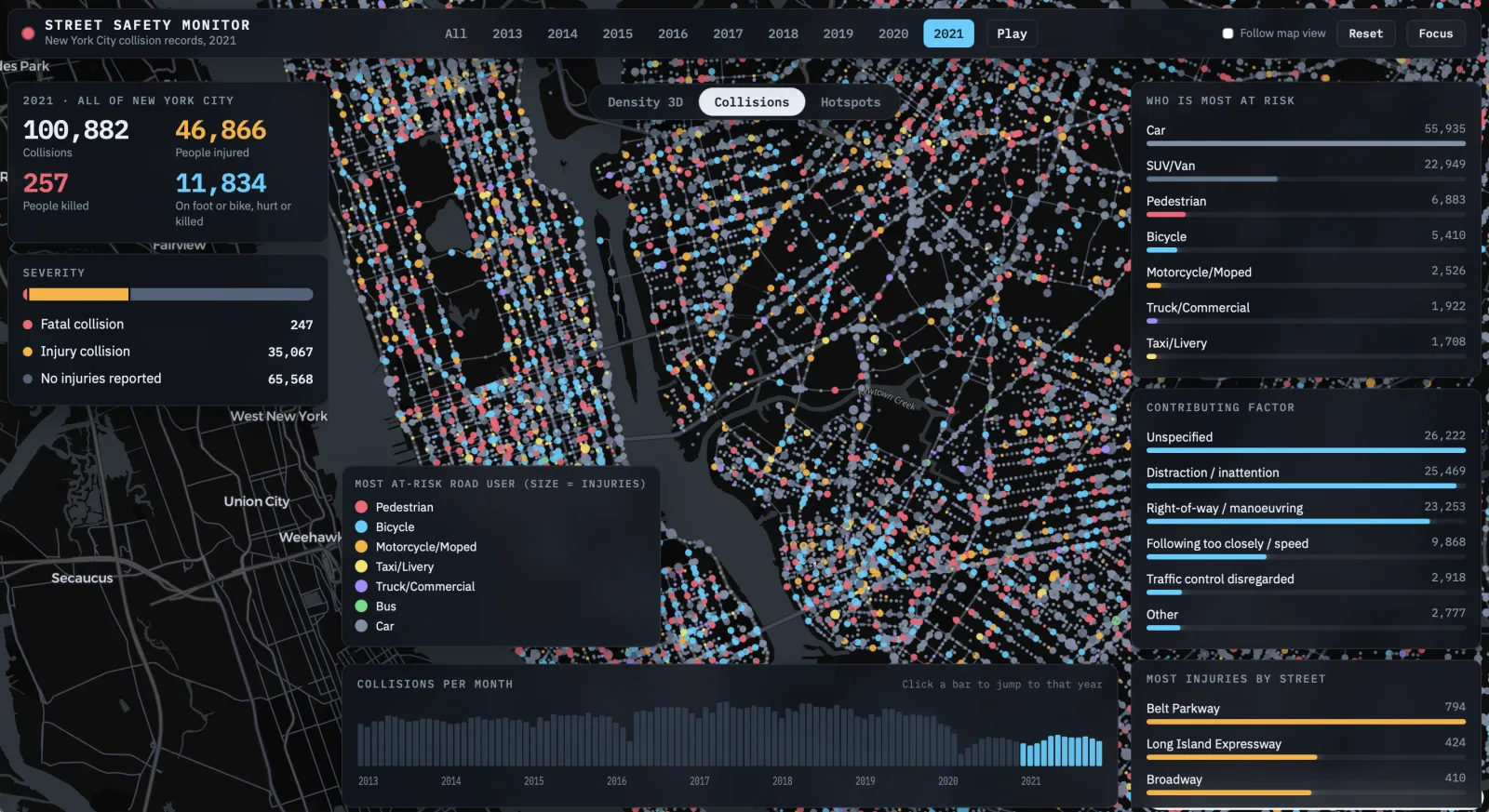
A better way to see where fraud happens
Insurance fraud alone costs the United States an estimated $308.6 billion a year, according to the Coalition Against Insurance Fraud (2022).
Fraud teams have the signals but not the geography. CARTO lets you add the spatial layer inside the warehouse where the data already lives, so investigators get answers and nothing is copied out.
* Describes typical setups. Individual tools and teams vary.

BI dashboards
Exported into the dashboard, or sampled
In-house visualization layers
Copied into a separate store with its own pipeline
CARTO
Queried in place in your warehouse
BI dashboards
Tables and totals, unable to work with billions of events and claims
In-house visualization layers
Custom tiling code, reworked as volume grows
CARTO
Runs inside your warehouse, so maps and analysis stay fast on billions of events and claims
BI dashboards
Weather and hazard data looked up by hand
In-house visualization layers
One-off scripts for each check
CARTO
Weather, hazard, and imagery data from sources like the Data Observatory and Google Earth Engine, enriched directly in your warehouse
BI dashboards
Wait for an analyst to build a new report
In-house visualization layers
Have the author rerun the script
CARTO
Build AI Agents and MCP tools so investigators and claims handlers can question your data and analysis, in Builder maps or in agent platforms like ChatGPT
BI dashboards
Screenshots and static reports
In-house visualization layers
A bespoke portal that engineers maintain
CARTO
Live maps and agents, embeddable for customers, with every query logged and auditable, whether your team or its AI Agents ran it
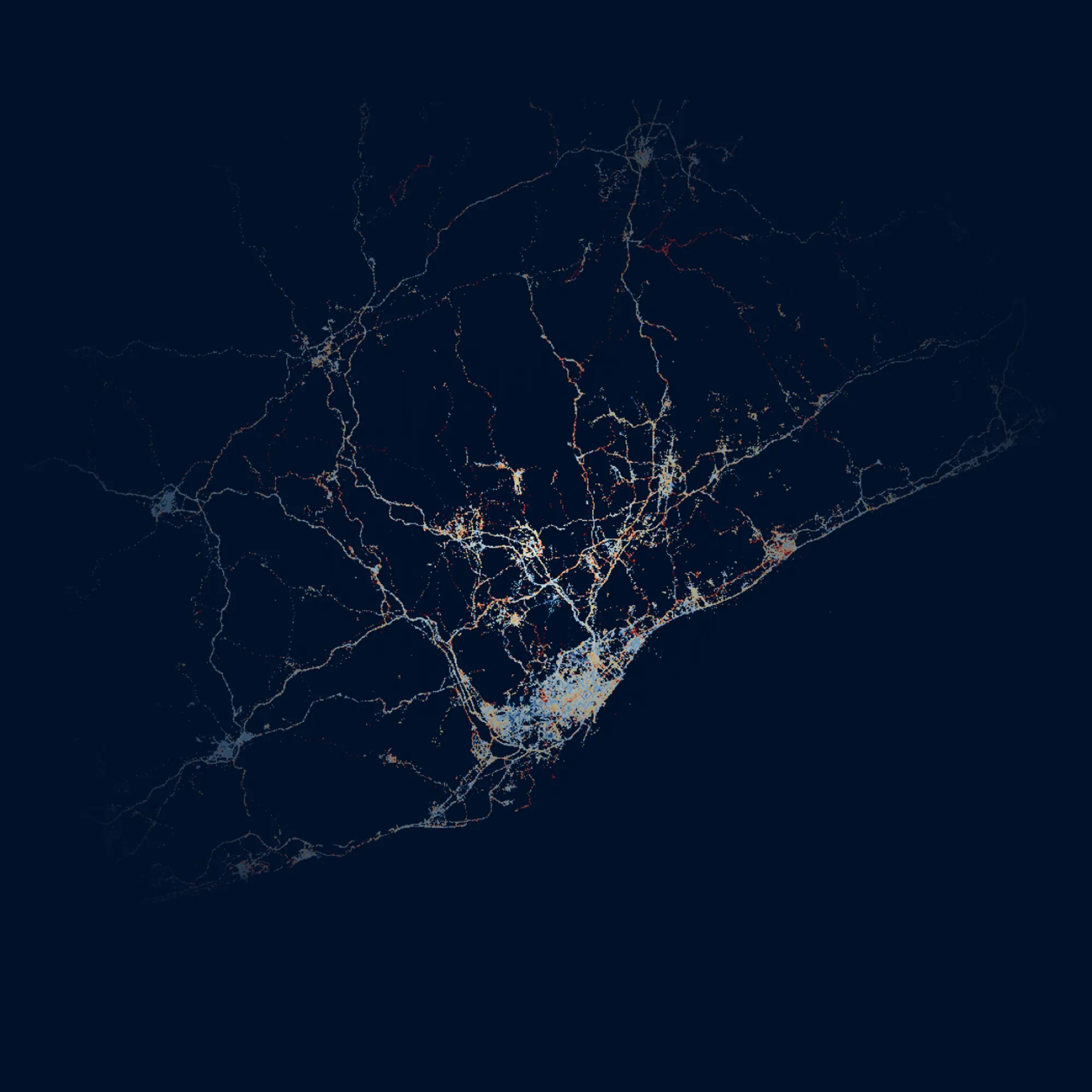

The context around every claim
Bring in weather, hazard, demographic, and imagery data from more than 12,000 datasets in the Data Observatory, or pull it from external APIs and services like Google Earth Engine, with satellite imagery search available inside Workflows.
Frequently asked questions
Many teams do build a visualization layer, and it works until the work around it grows: tiling, filters, permissions, sharing, and maintenance. With CARTO those pieces are already built, and your engineers can extend them with deck.gl where the product is unique to you, so they spend their time on what only you can build. See CARTO for developers.
Yes. CARTO lets you run the analysis inside your existing cloud data warehouse (BigQuery, Snowflake, Redshift, Databricks, or Oracle), under your access controls, and CARTO can also be self-hosted. AI Agents can use the model you choose, including your own.
Yes. CARTO is built to handle billions of points. Because CARTO is cloud-native, the analysis runs inside your warehouse and scales with it, and formats like spatial indexes (H3, for example) and dynamic tiling mean a map loads only what is on screen, not every row. For very large volumes, the best check is a short technical evaluation on your own data, with your volumes and your filters.
Join each claim to the weather, hazard, and imagery data for its place and date, from the Data Observatory or from external APIs and services like Google Earth Engine, then flag the claims that don't match the event or sit out of line with their neighbors. Spatial joins and hotspot analysis do the matching and the clustering, and a composite score ranks the cases for investigators.
Fraud has a geography: claims cluster after the same event, devices cluster in the same places, and transactions show up where the customer could never have been. GIS adds that view. In CARTO, hotspot analysis, spatial joins, drive-time analysis, and composite scoring run as reusable Workflows on your own cloud data, and investigators explore the results on live maps and with AI Agents.